
Perry is a Houston County seat with a housing mix that spans well over a century, and that range means the diagnosis matters more here than the treatment. An 1890s house near downtown Perry and a 2015 build off Perry Parkway have almost nothing in common from a moisture standpoint, and a contractor applying one approach to both will get it wrong half the time.
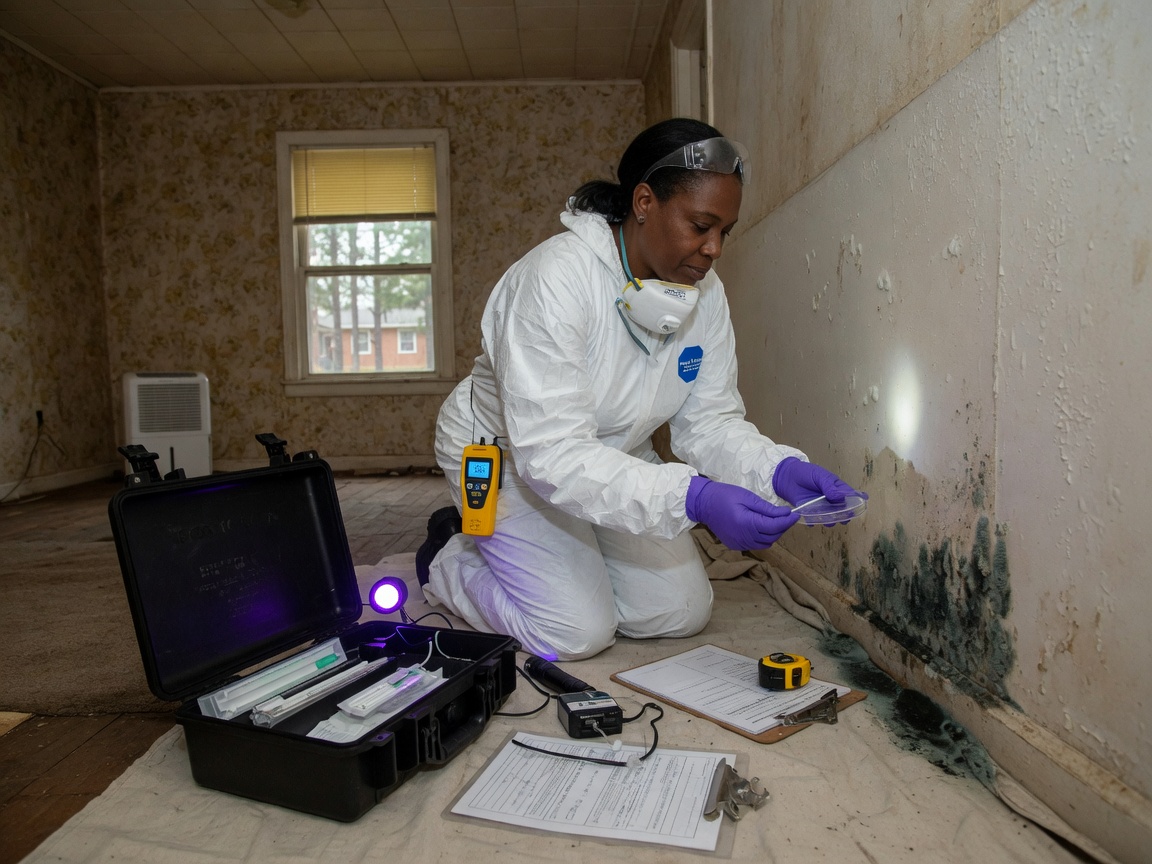
The older core follows the pattern of Macon's historic districts: open crawl spaces over bare clay, no vapor barrier, plaster over wood lath, original single-glazed windows, and retrofitted air conditioning running through unconditioned attics. Ground moisture rising through the floor is the leading cause, with sweating attic ductwork second. Plaster conceals growth and reads unreliably on a surface meter, so finding the actual boundary of a colony here takes a pin meter or a cavity check rather than a visual estimate.
Newer Perry construction has the opposite profile — slab-on-grade, tight envelope, oversized air conditioning that short-cycles and never dehumidifies, and builder-grade flashing details. Growth appears at floor level and in closets rather than under the house, and the cause is usually mechanical.
What is distinctive about Perry is the outbuildings. This is an agricultural county, and properties routinely include barns, workshops, equipment sheds and detached garages that are unconditioned year-round. Those hold humidity through every season, and stored contents in them — leather, upholstery, paper, tools, feed — develop growth without any water event. Clients often call about the house and the actual loss is in the shed. We inspect outbuildings when they are part of the property rather than treating them as out of scope.
The Georgia National Fairgrounds brings event-season traffic and a cluster of short-term lets and guest accommodation that sit empty between bookings. A closed, unconditioned guest unit in July behaves exactly like an empty rental anywhere else in this climate: three weeks sealed up is enough for visible growth on soft furnishings and closet walls. If you manage short-term accommodation in Perry, leaving the air at 78 between bookings is the cheapest prevention available.
Which page applies depends on the age of the property. Older downtown housing needs historic home mold remediation and crawl space encapsulation; newer builds off the parkway need indoor air quality testing and mold and mildew removal. Mold inspection and testing establishes which, attic mold removal covers sweating ductwork, and outbuilding contents fall under carpet and furniture mold removal. Short-term lets and businesses: commercial mold remediation. All services; nearby Warner Robins, Centerville, Byron and Houston County.
Around Perry
We regularly work near:
- 📍Georgia National Fairgrounds
- 📍Perry Parkway
- 📍Carroll Street
- 📍Houston Lake
- 📍Main Street
- 📍Perry Hospital
Mold Remediation in Perry — Local Notes
- •Housing spans the 1890s to new construction, so cause diagnosis matters more than treatment method.
- •Older downtown housing has open crawl spaces over bare clay and plaster over lath that hides colony boundaries.
- •Newer construction off the parkway tends toward oversized short-cycling air conditioning and builder-grade flashing faults.
- •Agricultural outbuildings — barns, workshops, sheds — stay unconditioned year-round and are a common site of contents loss.
- •Short-term lets around the Georgia National Fairgrounds sit closed between bookings, which in summer is enough to start growth.