
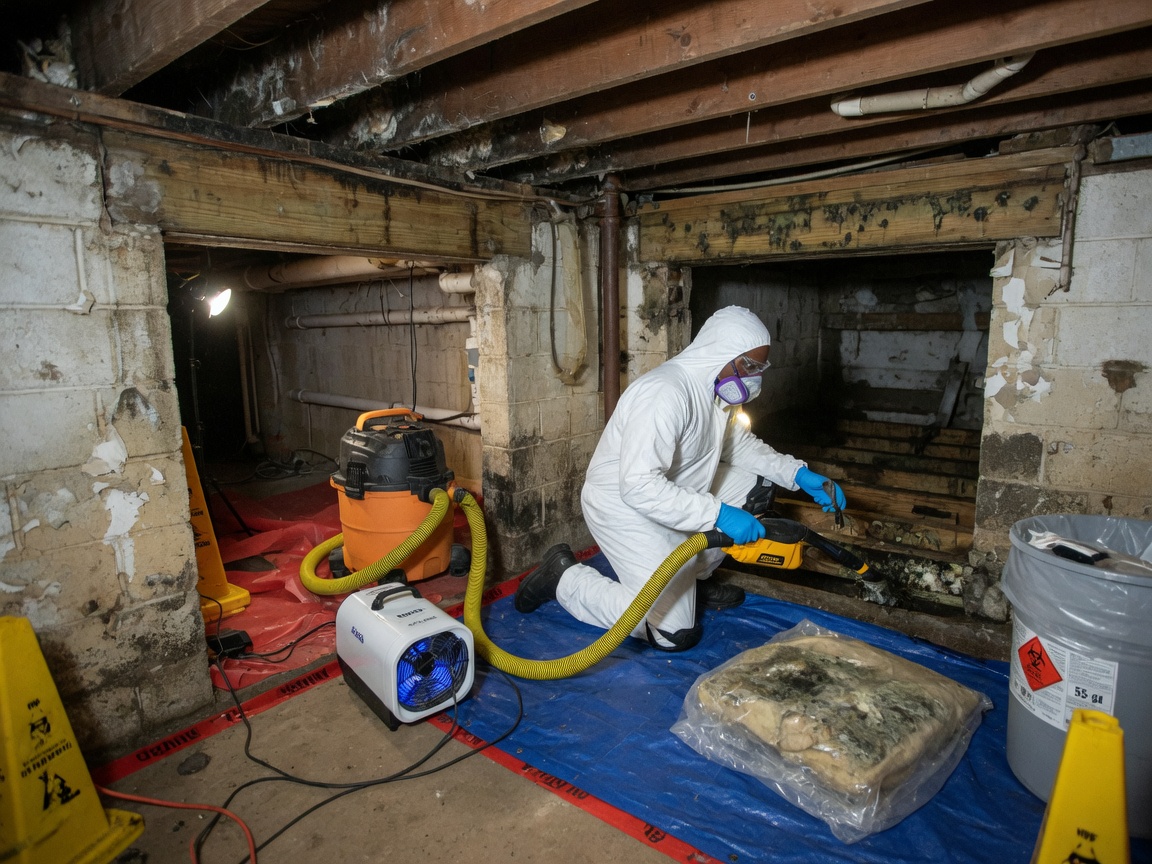
Gordon sits in Wilkinson County east of Macon, a small rural town in an area long associated with kaolin mining. The housing is mostly older and rural, properties are spread out, and well and septic systems are the norm. The moisture problems here are consistent and, for the most part, straightforward to diagnose once someone actually looks under the house.
Open crawl spaces over bare clay are the leading cause of everything we are called for. Older housing on brick piers or block, no vapor barrier in most cases, and soil that releases moisture continuously in this climate. The air in the house moves upward, carrying that moisture and its spores into the living space, so the complaint usually arrives as a musty smell in a back bedroom or a closet rather than as anything visible. Treating the room accomplishes nothing; the growth is on a joist below it.
Wilkinson County's clay soils drain slowly, which compounds it. Storm water that falls faster than the clay can absorb sits against foundations for days, and mild Georgia winters never freeze-dry the crawl space, so there is no seasonal reset. Moisture control here has to work in January as much as in July, which is why a sealed liner and a dedicated dehumidifier outperform any amount of ventilation.
Well and septic systems add sources that municipal properties do not have. A failing or saturated septic field keeps the surrounding ground wet and, on sloping ground, sends that water toward whatever sits downhill. Unconditioned well houses and pressure tanks condense routinely. Neither is dramatic, and both are regularly the genuine source behind a crawl space problem that has already been treated once without success.
Outbuildings are standard on properties here and worth including in any inspection. Barns, sheds, workshops and detached garages stay unconditioned year-round, and stored contents in them develop growth from humidity alone — no leak required. We inspect them as part of the property, and we would rather tell you the real loss is in the shed than quote the house and leave you with the actual problem.
Start with crawl space encapsulation, which addresses the bare clay behind nearly every call out here, and mold inspection and testing to confirm whether the water is arriving from outside. Basement and crawl space mold remediation covers the cleaning, black mold removal growth inside the house, and carpet and furniture mold removal contents stored in outbuildings. For an active leak, water damage restoration. All services; nearby Jeffersonville, Milledgeville and Gray.
Around Gordon
We regularly work near:
- 📍Highway 18
- 📍Highway 243
- 📍Wilkinson County
- 📍Main Street
- 📍Gordon City Hall
Mold Remediation in Gordon — Local Notes
- •Older rural housing on brick pier or block foundations over bare clay, mostly without any vapor barrier.
- •Wilkinson County clay drains slowly, holding storm water against foundations for days after rainfall.
- •Mild winters never freeze-dry crawl spaces, so moisture control has to run year-round rather than seasonally.
- •Well and septic systems introduce moisture sources municipal properties do not have, especially on sloping ground.
- •Unconditioned barns, sheds and workshops hold humidity all year and often hold the real contents loss.