
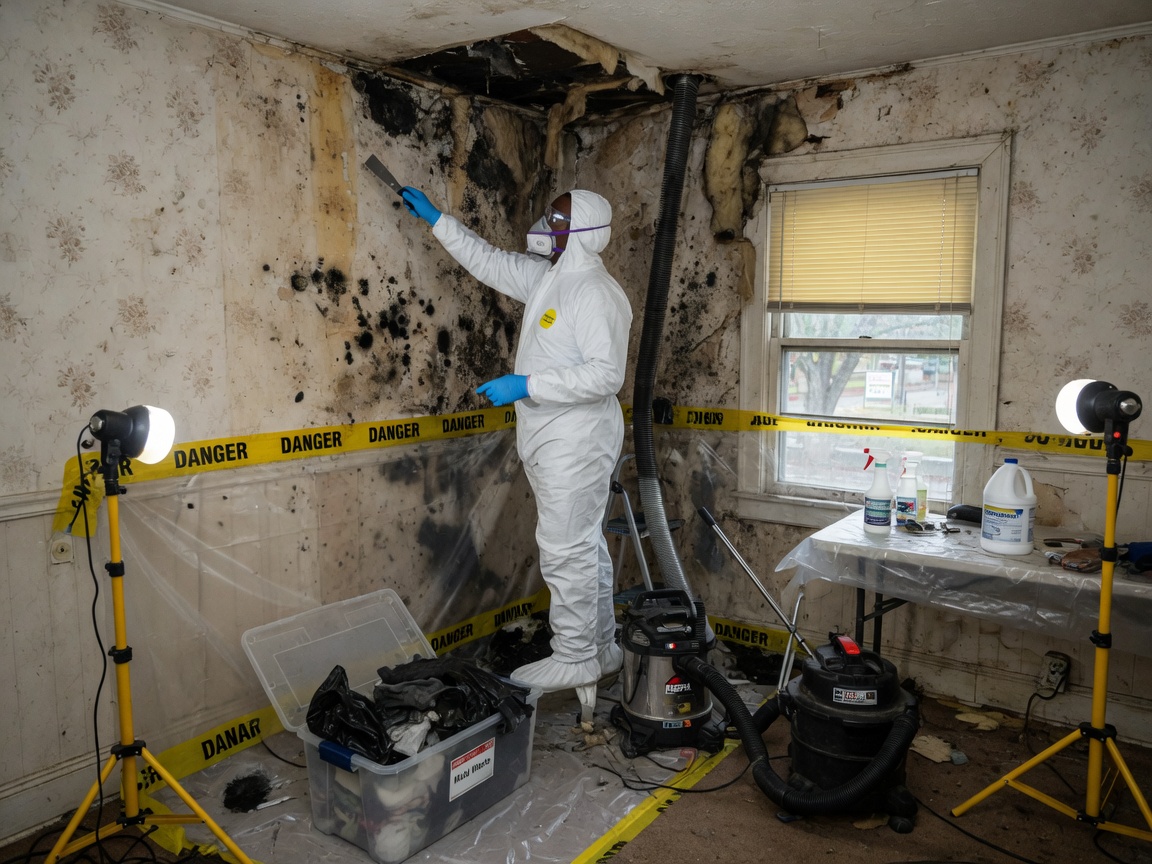
The Intown neighbourhood, part of the Cherokee Heights district and including the College Hill section, holds some of the largest and most architecturally significant houses in Macon — landmark nineteenth century homes built for the city's wealthiest residents, many of them the work of prominent local architects. Mold work in these buildings is the most demanding residential remediation we do, and the default approach is the wrong one.
Standard remediation practice is to remove everything within a couple of feet of the growth and replace it. In a house like this, that destroys fabric that cannot be bought back — original plaster with hand-run cornices, heart pine, custom millwork, and joinery that was expensive when it was new and is irreplaceable now. The remediation can easily cost less than what a careless crew removes. Our scoping on these properties is deliberately conservative: establish the actual boundary with a pin meter, thermal imaging and small borescope holes, then remove only what is genuinely compromised.
Scale creates its own problem. These are large houses with multiple additions accumulated over a century, which means complex roof geometry — valleys, dormer junctions, dead-level transitions, and flashing details at every place one roof plane meets another. Those junctions are what fail, and water entering at a valley tracks along a rafter before it drops, sometimes several feet, so the growth appears well away from the failure point. In a house with rooms that are not used daily, a leak can run for months before anyone notices an odour.
The mechanical systems are almost all retrofitted and that is the second major cause. Air conditioning added to a house built generations before it existed means flex duct through unconditioned attics and sometimes through floor cavities, and wherever that insulation has compressed or torn, cold metal condenses moisture continuously through the cooling season and drips onto the ceiling below. Growth on a ceiling under a sound roof is a duct problem far more often than a roof problem in this housing.
Two regulatory points apply here. Street-visible exterior alterations in a local historic district may require review, so where the cause is an exterior condition we scope around what is realistically approvable and raise it early. And this housing predates 1978 without exception, so painted surfaces should be assumed to contain lead until tested — disturbing them during demolition creates lead dust, which in a house with young children is a more serious risk than most mold findings.
On houses of this significance the relevant page is historic home mold remediation, and the work always begins with mold inspection and testing so the scope stays conservative. Ceiling growth under a sound roof is covered by attic mold removal, roof and valley intrusion by water damage restoration, and the foundation by crawl space encapsulation. Black mold removal covers the removal, and carpet and furniture mold removal the contents. All services; nearby College Hill Corridor, Downtown Macon and Huguenin Heights.
Around Intown Macon
We regularly work near:
- 📍College Street
- 📍Coleman Hill Park
- 📍Mercer University
- 📍Orange Street
- 📍Georgia Avenue
Mold Remediation in Intown Macon — Local Notes
- •Landmark nineteenth century houses where careless demolition costs more than the mold did.
- •A century of additions creates complex roof geometry, and valley and flashing failures surface far from the entry point.
- •Large floor areas with rarely used rooms let leaks run for months before anyone notices an odour.
- •Retrofitted air conditioning through unconditioned attics sweats onto ceiling plaster through every cooling season.
- •All of this housing predates 1978, so painted surfaces require lead-safe handling during any demolition.