
North Highlands sits on a hilltop above downtown Macon and the Ocmulgee River, developed between roughly 1890 and the 1940s and added to the National Register in 1993. The elevation is the defining feature for this work, and it cuts both ways in a manner worth understanding before you get quotes.
The good news first. Being up on the ridge means North Highlands largely escapes the groundwater and seepage problems that affect low-lying Macon neighbourhoods near the river. You are unlikely to have water arriving through a foundation from a high water table here. The consequence is that the remaining causes get exposed, and the dominant one is condensation — which is harder to spot because there is no leak to find and nothing visibly wrong.
Exposure is the specific hilltop problem. A house on a ridge takes wind-driven rain directly against its walls in a way a sheltered house does not. Summer thunderstorms and tropical remnants push water horizontally into window and door perimeters, at siding joints, and against the windward elevation, and it enters at details that handle vertical rain perfectly well. The telltale is damp concentrated on one elevation — usually the one facing the prevailing weather — rather than distributed around the house. Flashing, sealant joints and window perimeters on that face are where we look first.
The sloping sites also mean more partial basements and below-grade walls than flat Macon neighbourhoods, built into the hillside. An uphill below-grade wall is in contact with wet clay after every rain, and without exterior waterproofing or an interior drain, moisture moves through the masonry continuously. Growth appears low on the wall and behind anything stored against it.
The housing itself follows the regional pattern for its age: plaster over wood lath that hides growth and reads unreliably on a surface meter, original single-glazed sash, and air conditioning retrofitted through unconditioned attics with flex duct that sweats onto ceiling drywall through every cooling season. Growth on a ceiling with a sound roof above it is a duct problem here much more often than a roof problem, and that misdiagnosis has cost North Highlands homeowners entire roof replacements.
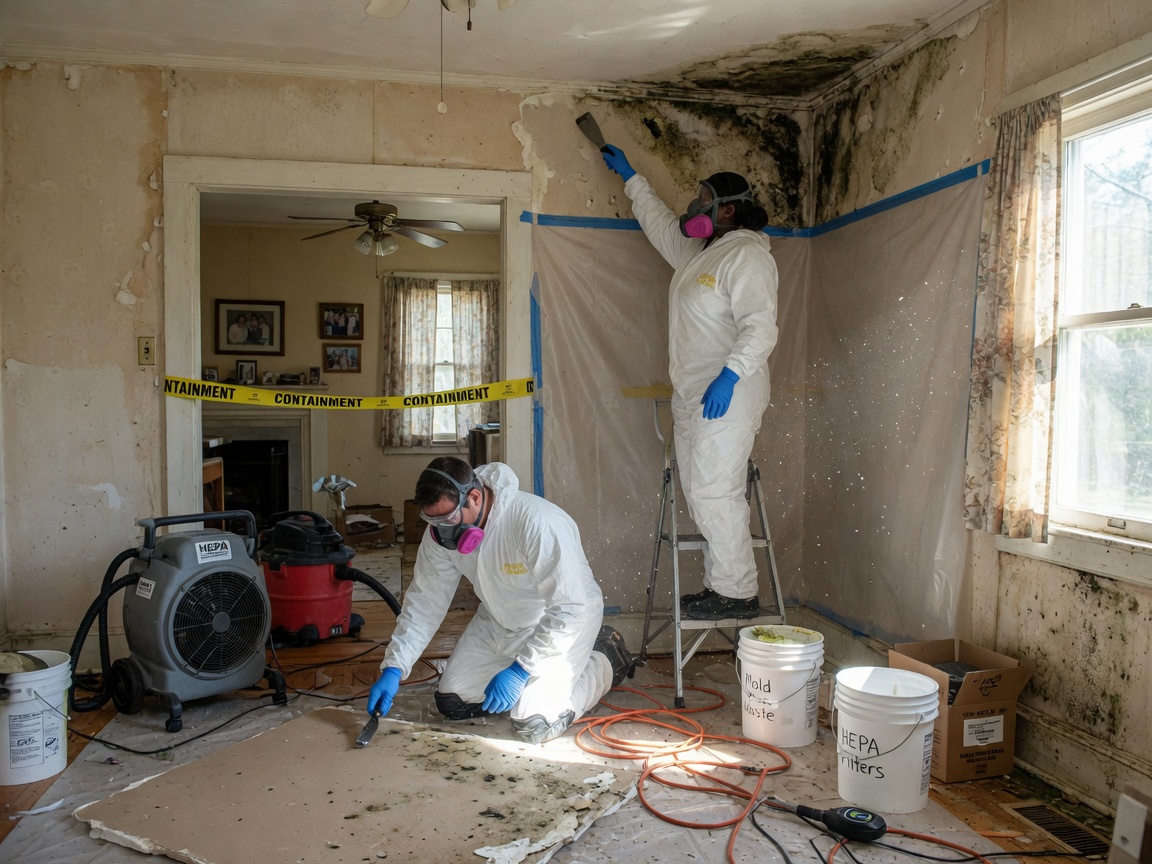
Because there is usually no leak to find here, mold inspection and testing and indoor air quality testing are the useful first steps. Ceiling growth under an intact roof is attic mold removal; below-grade walls fall under basement and crawl space mold remediation and crawl space encapsulation. Wind-driven rain damage goes to water damage restoration, and original plaster to historic home mold remediation. All services; nearby Shirley Hills, Downtown Macon and East Macon.
Around North Highlands
We regularly work near:
- 📍Ocmulgee River
- 📍North Highlands Historic District
- 📍Riverside Drive
- 📍Woodliff Street
- 📍Spring Street
Mold Remediation in North Highlands — Local Notes
- •Ridge-top elevation means condensation and wind-driven rain rather than groundwater are the dominant causes.
- •Exposed hilltop sites take wind-driven rain horizontally against the windward elevation during summer storms.
- •Damp concentrated on one elevation points to flashing and window perimeter details rather than a general problem.
- •Hillside construction gives more partial basements, with uphill below-grade walls against wet clay after rain.
- •Retrofitted attic ductwork sweats onto ceilings, a misdiagnosis that has cost homeowners unnecessary roof replacements.