
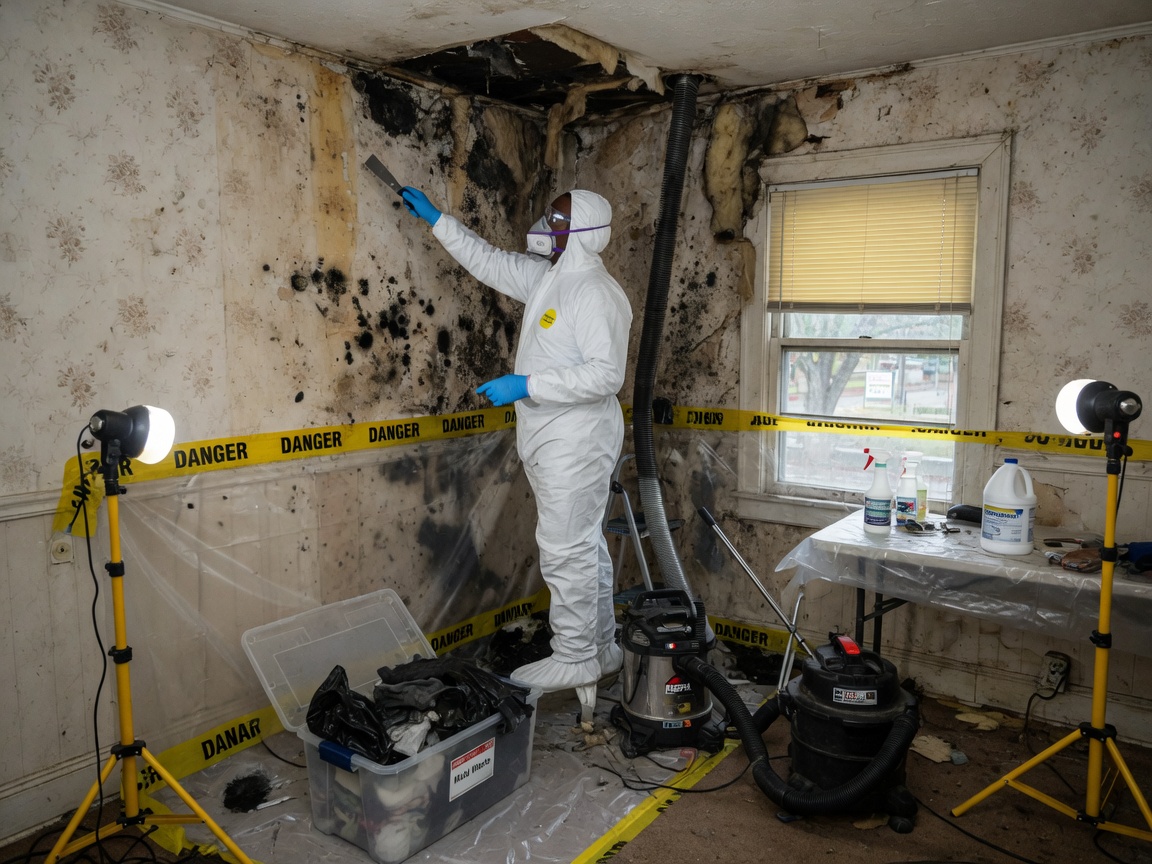
Pleasant Hill is one of Macon's most historically significant neighbourhoods, established in the late nineteenth century as a major Black community and listed on the National Register. The housing is predominantly late 1800s through the 1930s, and today it holds a mix of long-held family homes, restored properties, rental housing, and homes still awaiting investment. Those conditions need different approaches, and the same 1900 cottage can present entirely differently depending on which it is.
Across all of them the construction is consistent and the problems follow from it. These houses sit on brick piers over bare clay with no vapor barrier, so ground moisture rises into the floor structure continuously — the baseline condition under most Pleasant Hill housing and the reason the odour typically shows up in a closet or back bedroom rather than anywhere visible. Sealing the crawl space is nearly always the highest-value single item on a quote here, and where the budget is limited that is the part we would keep.
Deferred maintenance is the honest factor in some of this housing, and it changes the conversation. Where a roof has been leaking for years, where original windows have lost their glazing putty, or where a porch roof has been shedding water against a wall for a decade, the mold is a symptom of a repair backlog rather than a discrete event. We will tell you plainly when remediation alone will not hold, because cleaning growth under an active leak is money spent twice. In those cases we try to sequence the work so the most important repair comes first rather than quoting everything at once.
Air conditioning is retrofitted throughout, with flex duct through unconditioned attics that sweats onto ceilings where the insulation has failed, and bathrooms added long after the original construction, frequently with fans that terminate in the attic rather than outside. Both are common and both are comparatively cheap to correct — a fan reroute is a few hundred dollars and it removes a daily moisture source from the roof structure.
A note that applies to all of this housing: it predates 1978 without exception, so painted surfaces should be assumed to contain lead until tested. Disturbing them during mold demolition creates lead dust, which in a house with young children is a more serious health risk than most mold findings. Lead-safe work practices apply, and we quote them as a visible line item rather than burying the cost or ignoring the issue.
The two cheapest useful starting points are crawl space encapsulation and attic mold removal, which between them address ground moisture and attic-vented bath fans. Mold inspection and testing establishes the cause first, black mold removal covers removal, and historic home mold remediation explains how we handle plaster and lead-safe work on pre-1978 paint. Where a roof is still leaking, water damage restoration comes first. All services; nearby Beall's Hill, Downtown Macon and Fort Hill.
Around Pleasant Hill
We regularly work near:
- 📍Pleasant Hill Historic District
- 📍Little Richard House
- 📍Jefferson Long Park
- 📍Monroe Street
- 📍Middle Street
Mold Remediation in Pleasant Hill — Local Notes
- •Historically significant late-1800s to 1930s housing in mixed condition: family-held, restored, tenanted and awaiting investment.
- •Brick pier foundations over bare clay with no vapor barrier are the baseline moisture condition.
- •Where maintenance has been deferred, mold is a symptom of a repair backlog rather than a discrete event.
- •Retrofitted attic ductwork and later-added bathrooms with attic-vented fans are common and cheap to correct.
- •All housing predates 1978, so painted surfaces need lead-safe handling during any demolition.