
Cherokee Heights was one of Macon's first planned residential suburbs, and the district takes in several distinct sub-neighbourhoods including Intown, Huguenin Heights and Tattnall Square Heights. The housing is largely 1910s to 1940s, built to a plan rather than piecemeal, and that planning has consequences a century later.
Because the neighbourhood was laid out deliberately, the original drainage was engineered — but engineered for 1915, with a smaller tree canopy, far less paving and no modern additions. A century on, that grading has been altered on most properties by added driveways, patios, garages, extensions and decades of landscaping. In a good proportion of Cherokee Heights houses the ground now falls toward the foundation on at least one side, which is the opposite of the design intent. Part of every assessment here is an exterior walk to see where water actually goes, because a regrade and a downspout extension is frequently cheaper and more effective than anything done under the house.
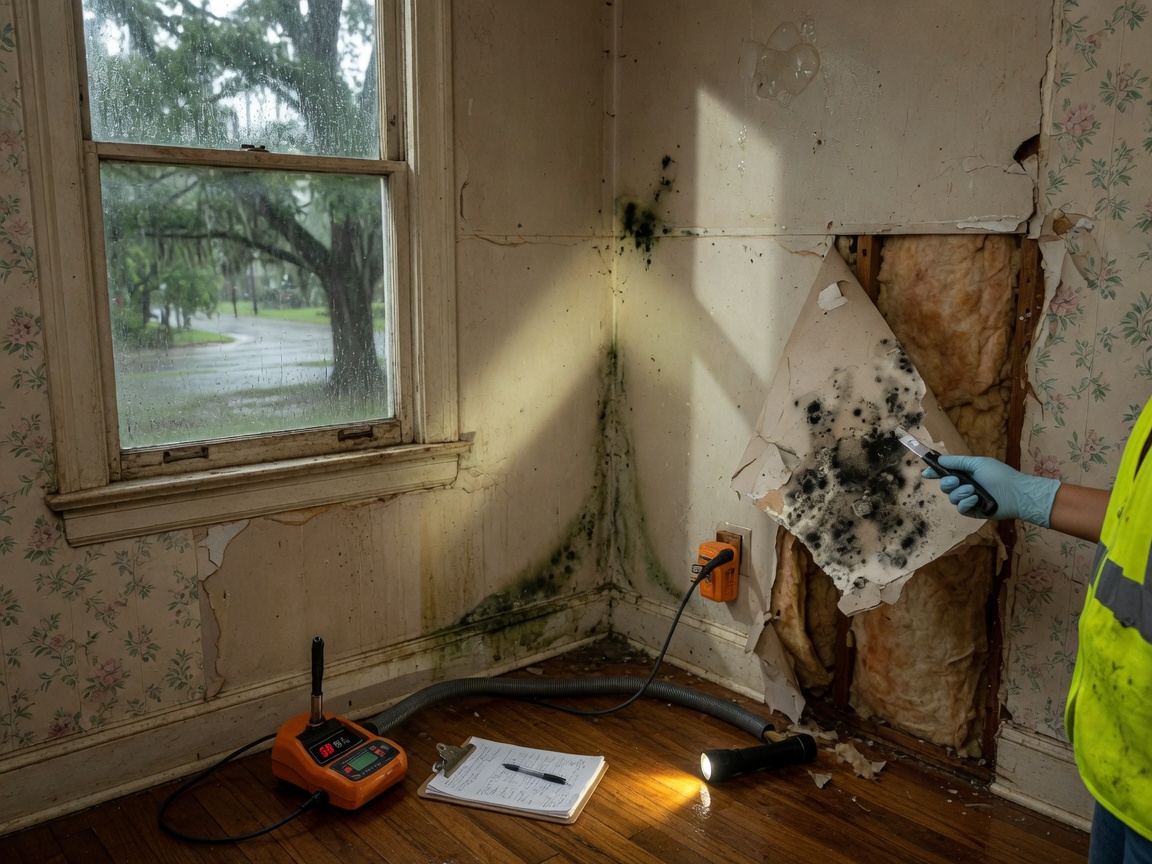
The housing stock is consistent enough to be predictable. Plaster over wood lath, which hides growth in the cavity between plaster and lath and reads unreliably on a surface moisture meter — so finding the real boundary of a colony takes a pin meter or a borescope rather than a visual estimate. Open crawl spaces over bare clay, generally with no vapor barrier, releasing moisture into the floor structure continuously. And original single-glazed sash windows, where worn glazing putty lets condensation run down and sit on the sill and apron through the cooling season.
Air conditioning was retrofitted into all of this housing, which means flex duct run through unconditioned attics that reach 130 degrees in July. Wherever that insulation has compressed, torn or pulled apart at a joint, the cold metal condenses moisture out of the attic air continuously and drips onto the decking or the ceiling drywall below. This is the most frequently misdiagnosed problem in this age of housing — homeowners reroof a sound roof, and the growth returns the following summer.
The mature canopy that makes Cherokee Heights attractive also keeps roofs and north-facing walls shaded and slow to dry after rain, and fills gutters and roof valleys with debris throughout the year. A meaningful share of the calls from this district trace back to a blocked valley or an overflowing gutter rather than to a roof that has actually failed, which is worth checking before you spend anything.
The three places we look are covered by three pages: crawl space encapsulation for the bare clay underneath, attic mold removal for sweating ductwork, and historic home mold remediation for plaster and original sash. Start with mold inspection and testing so the cause is established before anything is opened, and use black mold removal for the removal itself. All services; this district also takes in Intown Macon, Huguenin Heights and Tattnall Square Heights.
Around Cherokee Heights
We regularly work near:
- 📍Tattnall Square Park
- 📍Mercer University
- 📍Cherokee Avenue
- 📍Napier Avenue
- 📍Vineville Avenue
Mold Remediation in Cherokee Heights — Local Notes
- •Planned 1910s suburb whose original engineered drainage has been altered by a century of additions and landscaping.
- •Ground now falls toward the foundation on at least one side of many properties, reversing the design intent.
- •Plaster over lath hides growth in the cavity and reads unreliably on surface moisture meters.
- •Retrofitted attic ductwork sweating onto ceilings is the most misdiagnosed problem in this age of housing.
- •Mature canopy keeps roofs and north walls slow-drying and fills gutters and valleys with debris year-round.